
Recovery & Resilience

You can't prevent everything from going wrong, but you can be prepared for when it does. We design resilience around what you're running, what you can't afford to lose and how quickly you need to recover.

Discover More
Recovery & Resilience

Plan for What Happens Next

When something goes wrong, the time to work out how you’ll recover has already passed.


Failures happen. What matters is whether your infrastructure is designed to limit the disruption and help you recover the systems and data your business depends on.


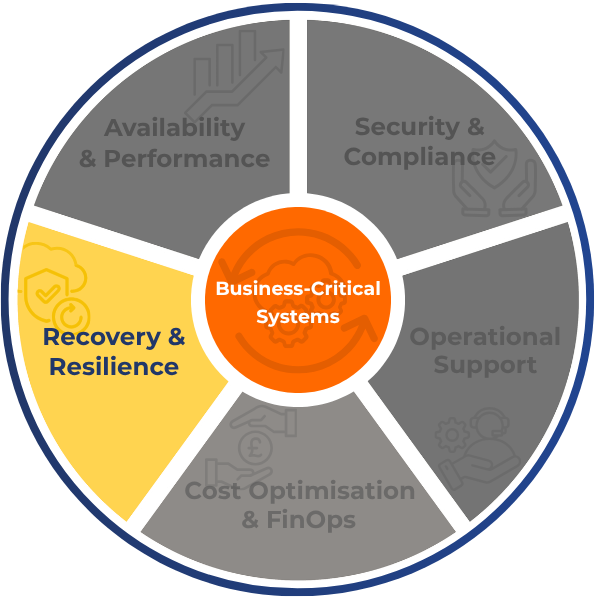
That’s why Recovery & Resilience is one of five core priorities in our approach to managed cloud. We work with you to understand what disruption would mean for your business, what needs protecting and how quickly you need to recover — then design the appropriate resilience around it.

The Problem

When You're Not Sure What Happens Next

Our Solution

How We Build Resilience Around You

  • A single failure could cause more disruption than it should
  • We identify where failures could have the biggest impact
  • You have backups, but you're not sure how quickly you could recover
  • We plan recovery around how quickly you need critical systems back
  • You don't know how much downtime or data loss you could realistically tolerate
  • We work with you to understand how much downtime and data loss your business could cope with
  • Recovery plans exist, but you don't know whether they'll work
  • We test recovery arrangements rather than simply assuming they'll work
  • Your infrastructure has changed, but your recovery arrangements haven't
  • We review your resilience as your infrastructure and requirements change

What Good Looks Like

Good resilience means knowing you're prepared if something goes wrong. Your critical systems and data are protected, you know what needs to be recovered and there's a clear plan for getting your business back up and running.

Prepared for Failure

We identify where failures could cause the greatest disruption and design the appropriate resilience around the systems your business depends on.

The Right Redundancy

We use appropriate redundancy and failover where it’s needed, based on what you’re running and the impact if it became unavailable.

Recoverable Data

We design backup and recovery around the data you need to protect, how much you could afford to lose and how quickly you may need it back.

Clear Recovery Targets

We establish how quickly critical systems need to be restored and how much data you could afford to lose, helping define appropriate RTO and RPO targets.

Tested Recovery

Where testing forms part of your service, we test recovery arrangements to establish that systems and data can be recovered as expected.

Recovery That Keeps Pace

As your infrastructure and requirements change, we review your recovery arrangements so they continue to reflect what you need.

Backup Is Only Part of the Picture

Having a backup doesn’t necessarily mean you’re ready to recover.


A backup gives you a copy of your data. But if something serious happens, you also need to know what needs to be restored, how you’ll restore it and how quickly you need it back.


For some systems, backup may be enough. Others may need greater resilience, replicated infrastructure, failover or a more comprehensive disaster recovery approach.


We’ll help you work out what genuinely needs protecting, how quickly it needs to recover and what level of resilience makes sense.


Explore Managed Backup Services →
Explore Disaster Recovery Services →

Explore the next principle

Availability & Performance →

Recovery & Resilience Explained

Cloud resilience is about making sure your critical systems and data can withstand disruption and recover when something goes wrong. Depending on what you’re running, this can include resilient infrastructure, redundancy, backup, failover and disaster recovery.

A backup gives you a recoverable copy of your data. Disaster recovery considers the wider process of restoring the systems, applications, infrastructure and data your business needs following a serious disruption.

Backups can be an important part of disaster recovery, but having backups alone doesn’t necessarily mean you have a complete recovery plan.

Recovery Time Objective (RTO) is how quickly you need a system or service to be restored following disruption.

Recovery Point Objective (RPO) relates to how much data you could afford to lose, usually measured in time.

The right targets depend on what you’re running and the impact downtime or data loss would have on your business.

No. Some systems may be critical to your day-to-day operations, while others could be unavailable for longer without causing significant disruption.

We look at what you’re running, what matters most to your business and what you need to recover, then design the appropriate level of resilience around it.

Testing can help identify gaps and establish whether systems and data can be recovered as expected. The type and frequency of testing will depend on your infrastructure, recovery requirements and the service you have in place.

Yes. We provide Managed Backup Services and Disaster Recovery Services, designed around what you’re running, the data you need to protect and how quickly you need to recover.

Explore Managed Backup Services →
Explore Disaster Recovery Services →

High availability is designed to help keep critical systems running when individual components fail. Disaster recovery focuses on restoring systems and data following a more significant disruption.

Depending on what you’re running and how critical it is, your resilience strategy may include one or both.

0800 817 4727